


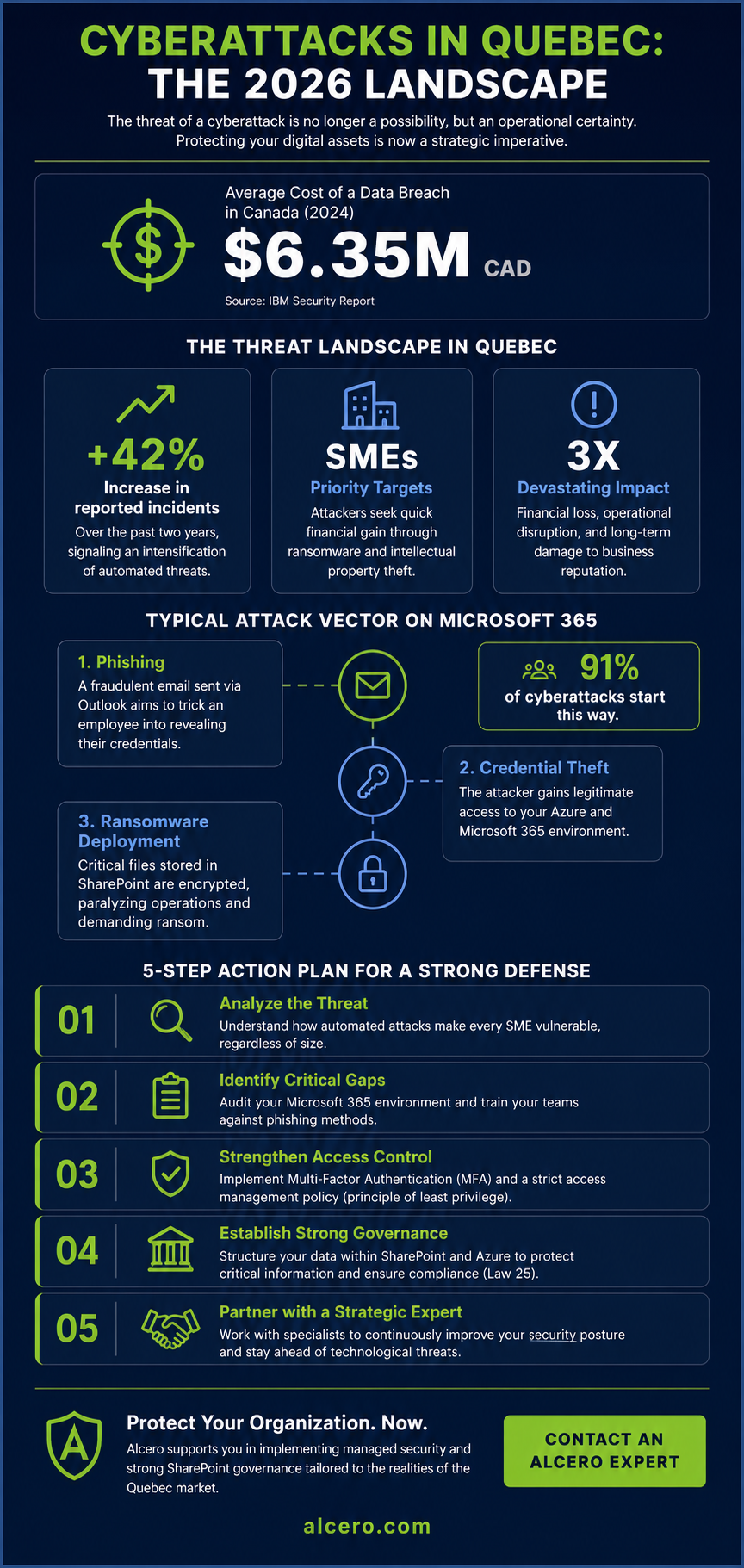
In 2024, the average cost of a data breach for Canadian businesses exceeded C$6.35 million, according to data published by IBM Security. This alarming statistic highlights an unavoidable reality for 2026: the threat of a sophisticated cyberattack is no longer a possibility, but an operational certainty that requires constant vigilance. You likely understand that protecting your digital assets on Azure or SharePoint now goes beyond simple technical management and has become a strategic governance imperative in the North American market.
The growing complexity of Bill 25 requirements in Quebec and the constant pressure tied to cloud migration require a flawless defense structure to prevent the loss of critical data. Alcero is committed to giving you the keys needed to identify, prevent, and neutralize digital attacks in order to secure your assets and ensure exemplary compliance. Through this analysis, you will discover how to establish a robust defense plan and guarantee business continuity, guiding your organization’s digital evolution with absolute technical mastery and quiet confidence.
Key Takeaways
- Analyze the threat landscape in Quebec in 2026 to understand why automated attacks make every SMB vulnerable, regardless of size.
- Identify the critical weaknesses in your Microsoft 365 environment and the phishing infiltration methods that compromise the integrity of your data.
- Adopt a structured five-step action plan to counter any potential cyberattack, focusing on multifactor authentication and rigorous access management.
- Establish exemplary document governance in SharePoint and Azure to ensure your company complies with local regulatory requirements.
- Discover how a strategic partnership with Alcero helps ensure the continuous evolution of your security posture against complex technology challenges.
What is a cyberattack and why are Quebec businesses targeted?
A cyberattack is defined as a deliberate and malicious action aimed at exploiting vulnerabilities in digital systems to steal, alter, or destroy strategic data. In 2026, this threat is no longer a simple technical challenge created by isolated hackers. It has become a highly organized financial extortion industry. For businesses in Laval and the greater Montreal region, the issue goes beyond basic IT protection. It is a matter of business continuity and preserving organizational value.
The threat landscape in Quebec in 2026 shows that our SMBs have become priority targets. Attackers are no longer looking only for recognition or random sabotage. They are targeting fast financial gain through ransomware or intellectual property theft. This shift in motivation makes every organization vulnerable, regardless of industry. The collateral impact of such an attack is devastating. Beyond material losses, the company’s reputation and the hard-earned trust of clients collapse. A successful cyberattack can damage a brand image for years, compromising any possibility of sustainable digital evolution.
The real consequences for a local business
Operational interruption is the most immediate and visible consequence. Imagine your system going down on a Monday morning, making it impossible to access orders or billing. The paralysis is total. Hidden costs then add to this productivity loss: cyber forensics expert fees, legal costs to manage disputes, and heavy regulatory fines. For a local business, the theft of client data is as serious as having its main delivery vehicle stolen. It is the work tool that disappears, immediately stopping the ability to serve the local market.
The threat landscape in Quebec in 2026
Recent statistics from the Commission d’accès à l’information (CAI) indicate a 42% increase in incidents reported by private organizations over the past two years. This figure shows that geographic proximity to major centres like Quebec City or Montreal no longer offers any natural protection. Networks are constantly scanned by automated scripts. It is risky to believe you can wait until the weekend to review your security protocols or update your Microsoft 365 solutions. Response must be immediate. Implementing rigorous document governance and a robust security architecture, especially on Azure, has become the central pillar of resilience for any modern Quebec business.
The most threatening types of cyberattacks for your Microsoft 365 infrastructure
The Microsoft 365 ecosystem is the productivity nerve centre for organizations in Laval. This centralization of critical data makes your tenant a priority target for malicious actors. A sophisticated cyberattack no longer aims only to interrupt services; it seeks to compromise the integrity of your document structure and the confidentiality of your communications. Hackers carefully analyze entry points, often prioritizing phishing through Outlook. According to 2023 security reports, nearly 91% of IT security incidents begin with a phishing attempt. The goal is clear: steal credentials to gain administrative access to your Azure environment.
Once access is secured, ransomware deployment can target your SharePoint libraries. Unlike traditional attacks on local servers, encryption here happens at the application level, which can paralyze thousands of files within minutes. At the same time, distributed denial-of-service attacks (DDoS) increasingly target extranet portals. These attacks overload your resources to block exchanges with clients and partners, directly harming your operational efficiency and commercial credibility in the North American market.
Specific vulnerabilities in SharePoint and Teams
The collaborative power of SharePoint and Teams carries inherent risks tied to access configuration. External sharing that is too permissive often exposes confidential documents to third parties without IT leadership being alerted. This poor document management makes it easier to exfiltrate sensitive data through users whose rights were never revoked. Identity impersonation within Teams channels is another serious threat. A hacker using a compromised account can manipulate your employees into revealing financial information or industrial secrets. To structure your defense, applying a game plan to strengthen your cybersecurity provides a rigorous baseline for any Quebec SMB looking to secure its digital future.
The danger of unauthorized third-party applications
Shadow IT represents a major security weakness in the digital evolution of businesses. When employees install unverified third-party applications to meet occasional needs, they often grant broad permissions across your Microsoft 365 tenant. These unauthorized integrations create backdoors in your Azure infrastructure, bypassing the standard monitoring protocols of your IT team. Implementing strict governance is essential to limit access rights and ensure regulatory compliance. Integrated document governance allows you to regain control over these peripheral tools and sustainably secure your information assets against any future cyberattack.
Myths and realities: Why your SMB is not safe
The idea that malicious actors focus their efforts only on large institutions, like the Desjardins case, is a major strategic mistake for entrepreneurs in Laval. Statistical reality contradicts this sense of security. Around 43% of cyberattacks specifically target small and medium-sized businesses. Hackers no longer operate manually. They deploy automated scripts that scan the web continuously to identify technical vulnerabilities, regardless of an organization’s size or revenue.
The concept of perimeter security based only on antivirus software and a firewall has become obsolete in 2026. These tools are only a superficial first layer. The evolution of threats shows that 90% of successful cybersecurity incidents stem from human error, often a simple click on a malicious link or the use of an overly predictable password. Protecting your digital assets now requires a comprehensive governance approach that includes continuous training and a Zero Trust architecture.
Security through obscurity is an illusion
Believing your business is too small to be noticed is a risky calculation. Scanning bots do not look for a brand name; they look for open ports and outdated software. Your presence on the dark web may already be a reality. Credentials from Quebec businesses are sold there daily for a few dollars, offering direct access to your Azure servers or Microsoft 365 environments. To establish solid foundations, consulting the Government of Canada cybersecurity guide helps identify the essential controls to put in place immediately. Leaving your systems unmonitored is like leaving your office door unlocked all weekend and simply hoping no one walks by.
Investing in security: expense or asset?
Financial leadership must view cybersecurity as a strategic asset rather than an operating expense. The cost of a cyberattack goes far beyond technical recovery costs. It includes productivity loss, compliance-related fines, and the irreversible erosion of client trust. A rigorous security posture becomes a powerful selling point during major calls for tenders. Clients now require concrete proof of data protection before signing a contract. You need to shop for your protection solution with the same rigor you would apply to property damage insurance. A proactive defense ensures the long-term continuity of your operations in the face of a constantly changing threat landscape.
Game plan: 5 steps to strengthen your cybersecurity posture
The digital resilience of Laval businesses depends on flawless tactical execution. Protecting infrastructure is never a matter of chance; it results from a proven methodology. To effectively counter any cyberattack attempt, your organization must adopt a proactive posture built around five fundamental pillars.
- Multifactor authentication (MFA): Enabling MFA on all accounts is the first line of defense. Microsoft statistics confirm that this measure blocks 99.9% of identity-related attacks.
- SharePoint governance: A rigorous audit of your access rights is essential. You must know exactly who accesses which data. Limiting rights to what is strictly necessary drastically reduces the scope of an intrusion.
- Continuous awareness: Your teams are your first line of defense. Regular training programs on digital risks turn your employees into effective alert sensors.
- Patch management: Systematic application of security updates eliminates vulnerabilities exploitable by malware. A delay of only a few days can sometimes compromise an entire network.
- Incident response plan: Confusion is the attacker’s ally. A clear, tested, and documented protocol allows precise action as soon as an alarm is triggered, minimizing downtime.
Compliance with Bill 25 in Quebec
Since September 22, 2023, Quebec’s legislative framework has imposed strict requirements. Businesses have a legal obligation to report any confidentiality incident that presents a risk of serious harm to the Commission d’accès à l’information. This process requires the official appointment of a person responsible for the protection of personal information. A high-performing document management system becomes a strategic asset here. It makes it possible to inventory, secure, and trace the use of sensitive data, making accountability easier in the event of a cyberattack or regulatory audit.
Securing hybrid and remote work
The traditional security perimeter has broken apart with the rise of mobile work. To protect your assets outside the office, the use of virtual private networks (VPNs) and Azure Virtual Desktop (AVD) is essential. These technologies ensure that data never leaves the company’s secure environment. At the same time, deploying a mobile device management (MDM) solution like Microsoft Intune makes it possible to control the compliance of phones and laptops used at home or in a café. This approach ensures that even access through public Wi-Fi remains protected from malicious interception.
The continuity of your operations depends on the strength of your technology infrastructure. To validate your defense protocols, call on our information governance advisors.
Alcero: Your strategic partner for managed security and SharePoint governance
Alcero structures its work around a rigorous methodology that aligns the protection posture with the organic evolution of your organization. This approach ensures that control measures never become a barrier to operational productivity. As a recognized expert in Azure and Microsoft 365 solutions, Alcero deploys robust architectures for businesses in Laval and the North Shore. Granular identity management and systematic encryption of sensitive data form the foundation of our technical expertise.
Alcero’s managed IT services provide 24/7 monitoring of your critical digital assets. This constant vigilance makes it possible to detect any attempted cyberattack before it can paralyze your day-to-day operations. Our operations centres process alerts in real time, giving decision-makers the technical control needed to navigate a complex threat environment. Alcero’s support also includes:
- Deployment of advanced security policies on Microsoft Defender.
- Optimal configuration of collaborative Teams and SharePoint environments.
- Implementation of immutable backups to counter ransomware.
- Proactive technical assistance to minimize downtime.
Implementing secure document governance is a central pillar of our service offering. We transform SharePoint into a tightly controlled environment where access control and file traceability meet the strictest compliance standards in your industry.
Why choose a local expert based in Quebec?
Alcero’s presence in Montreal, Laval, and Quebec City allows for an immediate understanding of the market’s economic and geographic realities. Our experts provide first-class French-language technical support and guarantee physical proximity for intervention when needed. This local expertise is crucial for the rigorous application of Quebec’s legislative framework, particularly Bill 25 requirements, whose latest provisions came into force in September 2023. We understand the legal nuances that govern the protection of personal information within your infrastructure.
Take action today
Your organization’s resilience begins with a comprehensive initial security audit. This diagnosis identifies critical vulnerabilities and defines a priority roadmap to strengthen your defenses. Alcero does more than correct technical flaws; the company turns your technology challenges into lasting competitive advantages. An optimized Microsoft 365 infrastructure drastically reduces the likelihood of suffering a costly cyberattack while streamlining internal processes. Contact our experts to secure your Microsoft 365 infrastructure and ensure the long-term sustainability of your digital assets with expert guidance.
Anticipate threats to protect the long-term value of your digital assets
In 2026, the threat of a cyberattack is no longer hypothetical but an operational certainty for Quebec organizations of all sizes. The growing complexity of Microsoft 365 environments requires constant technical vigilance, especially in light of Bill 25 requirements, which now impose extremely rigorous standards for protecting personal information. A resilient security posture depends on well-controlled SharePoint governance and an Azure infrastructure perfectly configured to block intrusions before they reach your critical data.
Alcero relies on more than 20 years of strategic IT consulting expertise in Quebec to guide the evolution of your information systems. Our certified Microsoft 365 and Azure specialists provide complete support to guarantee regulatory compliance and the security of your document processes. Do not leave the continuity of your operations to chance. Protect your business now with Alcero’s experts to turn your technology challenges into a lasting competitive advantage. Your transition to a secure infrastructure begins with a proven strategy.
Frequently Asked Questions About Data Protection and Cybersecurity
What is a ransomware cyberattack?
A ransomware cyberattack involves the infiltration of malicious software that encrypts an organization’s critical data and demands a ransom in exchange for the decryption key. In 2023, IBM’s report identified this attack vector as one of the costliest threats to Quebec digital infrastructures. This method paralyzes daily operations and compromises the integrity of the company’s document ecosystem.
How does Bill 25 affect cyberattack management in Quebec?
Bill 25 imposes a strict obligation to report any confidentiality incident involving personal information to Quebec’s Commission d’accès à l’information. Businesses must now maintain an incident register and notify affected individuals if there is a risk of serious harm. Failure to comply with these provisions can result in administrative monetary penalties of up to C$25 million or 4% of global revenue.
Is Microsoft 365 enough to protect me against cyberattacks?
Although Microsoft 365 offers native security features, a standard configuration is not enough to counter a sophisticated cyberattack without an active governance strategy. Enabling multifactor authentication and deploying solutions like Microsoft Purview are essential to securing SharePoint and Teams environments. Robust protection requires rigorous integration of compliance settings to close perimeter security gaps.
What are the first steps to take after detecting an intrusion?
Immediately isolating infected systems is the first critical measure to stop lateral movement within the network. IT leaders must then activate the incident response plan to identify the scope of the compromise before restoring immutable backups. This containment phase must be documented precisely to meet the accountability requirements set out by Quebec’s legislative framework.
How much does a cyberattack cost on average for a Quebec SMB?
The average cost of a data breach in Canada reached C$6.94 million in 2023, according to IBM data. For an SMB, the costs related to business interruption, technical recovery, and regulatory fines often range between C$150,000 and C$350,000. These amounts exclude long-term reputational damage that affects client retention and brand value.
How can I train my employees to avoid phishing traps?
Monthly phishing simulations can reduce malicious click rates from 30% to under 5% in a single year. Training should focus on identifying warning signs in emails and strictly following internal reporting protocols. Educated staff act as an essential human security layer to protect access to Azure and Office 365 collaborative environments.
Why is information governance linked to cybersecurity?
Information governance defines classification and retention protocols that limit the attack surface in the event of an intrusion. By precisely identifying where sensitive data is located in SharePoint, organizations can apply granular access controls and encrypt critical documents. This systematic approach ensures the company’s digital evolution is built on a healthy document structure that complies with industry standards.
What is the difference between a firewall and a managed security solution?
A firewall acts as a perimeter barrier that filters network traffic, while a managed security solution provides proactive monitoring and 24/7 threat response. Managed services integrate detection and response tools that analyze abnormal behaviour in real time to neutralize persistent threats. This centralized management provides superior technical control, essential to the long-term sustainability of complex IT infrastructures.